
In a bold move to position West Africa as a global manufacturing powerhouse, Ghana has unveiled an ambitious industrial roadmap that promises to redefine the region’s textile landscape. During the State of the Nation Address (SONA) delivered at the Parliament House in late February 2026, President John Dramani Mahama announced the strategic construction of three massive garment factories across the Eastern, Central, and Bono East regions. This initiative transcends mere infrastructure development; it is a calculated economic transformation strategy aimed at generating an estimated 27,000 new jobs for the Ghanaian workforce.
The project is designed to operate under the "24-Hour Economy" policy, a multi-shift labor model intended to maximize production capacity and efficiency. Each factory is projected to accommodate approximately 3,000 workers per shift. This government intervention comes as a direct response to Ghana’s surging non-traditional exports, which witnessed a dramatic 27.04% increase in the previous year, reaching a valuation of $4.87 billion. With these new facilities, Ghana aims to solidify its standing in the global supply chain, particularly under the framework of the African Continental Free Trade Area (AfCFTA).
The Minister for Trade, Agribusiness, and Industry, Elizabeth Ofosu-Adjare, emphasized that the garment sector holds a unique advantage due to its inclusive nature and its ability to achieve rapid labor absorption. In her briefing, she explained that the industry does not necessitate years of prior training before an individual can become productive. This sector serves as a vital solution to public concerns regarding educational certificates, which often act as a barrier to securing decent employment.
"The beauty of the garment industry is that you don't need to learn for three or five months before you start working. We can train you in four weeks, and you have a permanent job. The garment industry is here to give you a decent job, whether you have an educational certificate or not. We will train you on the job," stated Ofosu-Adjare.
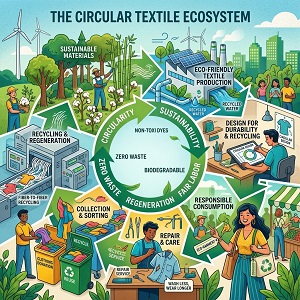
The strategy also encompasses government efforts to breathe new life into legacy textile giants that had previously lost their luster, such as Volta Star Textiles and Akosombo Textiles Limited. By integrating these new factories and revitalizing state-owned enterprises, Ghana aspires to create a comprehensive "farm-to-fashion" textile ecosystem. The selection of the Bono East region, for instance, was strategic due to its proximity to raw material sources, which is expected to significantly slash longitudinal costs and enhance overall production cost-efficiency.
Through close partnerships with the private sector and the support of international bodies like UNIDO, Ghana remains optimistic that 2026 will serve as a definitive turning point for national industrialization. The grand ambition is clear: to transform fabric and thread into the primary pillars of sustainable economic growth, while proving that Africa is more than capable of meeting global apparel demands with international quality standards.