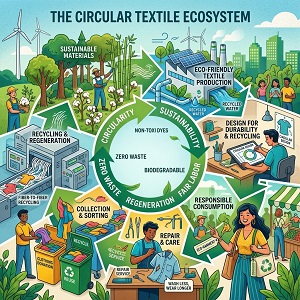

Europe’s fashion titans are executing a radical paradigm shift, moving beyond sustainability rhetoric toward the construction of hard industrial infrastructure. Through an ambitious initiative known as Project FAE (Feedstock Activation Europe), global apparel majors like adidas, Inditex, and Bestseller are no longer treating circularity as a branding exercise. Instead, it has become a critical strategy for margin defense. This consortium, backed by over 40 ecosystem players, aims to build the "missing link" in the circular economy: turning mountains of textile waste into spec-compliant, industrial-grade raw materials.
The primary challenge facing Europe today is not a lack of collection, but a systemic failure in conversion. Warehouses across the European Union are overflowing with non-rewearable garments that remain commercially unusable because recyclers cannot process contamination-heavy blends at an industrial scale. This mismatch has created a multi-billion-dollar supply inefficiency; Europe is long on waste inventory but structurally short on recycler-grade feedstock. Project FAE intervenes by repositioning discarded apparel not as municipal waste, but as an upstream commodity that requires "midstream refining."
"The highest-value intervention sits in pre-processing," notes a consortium representative. By deploying deep-tech operations like Near-Infrared (NIR) spectroscopy and polymer-sensitive automated sorting, Project FAE can isolate fibers with high purity. The ability to separate polyester from cotton without degrading the molecular chain could materially alter the cost curve of textile-to-textile recycling worldwide, making recycled fibers a viable competitor to virgin materials.
Beyond the technology, Project FAE is introducing a regional hub architecture concentrated in Northern Europe and the Iberian Peninsula. These hubs function as "textile refineries," converting chaotic waste inputs into standardized feedstock streams. For recyclers such as Infinited Fiber Company and Circ, this reduces inbound variability and improves plant utilization. For major brands, it enables long-term procurement contracts for recycled fibers that function more like commodity purchasing than sustainability experimentation.
Data is also emerging as the new sorting margin. By integrating Digital Product Passports (DPP) with optical sorting belts, partners like Texaid and Boer Group are closing the information gap that has historically undermined sorting economics. A projected 35% reduction in recycler rejection rates has direct balance-sheet consequences: lower wasted logistics and superior yield predictability. For companies like Inditex, this is a de-risking mechanism against the price volatility of virgin polyester linked to petrochemicals.
This industrial evolution is also a direct response to tightening regulations. The EU’s Extended Producer Responsibility (EPR) framework and the 2026 Circular Economy Act are effectively turning poor recyclability into a direct profit-and-loss liability. In this light, Project FAE is a strategic hedge against waste taxes and disclosure mandates. Fashion for Good, acting as the market architect, aims to lift Europe’s textile circularity rate to 24% by 2030. The market lesson is clear: circularity has migrated from a brand narrative to an industrial asset class. The winners of this decade will not just be the best recyclers, but those who control the feedstock gateways.