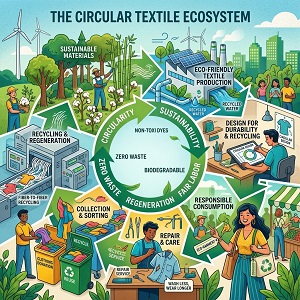

The textile and garment sectors have long served as vital drivers of economic growth in both Uzbekistan and Kyrgyzstan. However, as the European Union and other global markets enforce stricter sustainability standards, both nations face an urgent demand to adopt circular economy principles. A recent report by the United Nations Development Programme (UNDP) reveals that while environmental awareness is growing, the vast majority of enterprises in both countries still operate at a low level of circularity.
Clothing waste is a rapidly growing global issue, and Australia stands out as one of the highest garment-consuming nations, with a fashion carbon footprint that ranks as the largest among G20 countries. To combat this mounting crisis, researchers at the Royal Melbourne Institute of Technology (RMIT) have developed a sustainable method to transform cotton textile waste into nutrient-rich compost.
The French government has officially initiated a strategic new move, setting a deadline of January 8, 2027, to decide whether to push for textiles to be integrated into the European Union's Carbon Border Adjustment Mechanism (CBAM). This step marks a new chapter in trade debates that has the potential to drastically reshape the global textile supply landscape.
Page 1 of 11