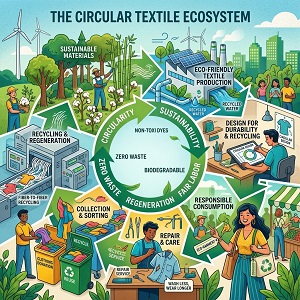

The global apparel industry is entering a critical redesign phase driven by sustainability goals, tightening regulatory pressures, and resource security centered around a single core principle: material simplicity. For years, consumers were encouraged to look for garments labeled "100% cotton" or "100% polyester" to support recyclability. Today, that label has evolved far beyond a basic sustainability marker, serving as a key indicator of how prepared a brand is for the next era of textile manufacturing.
Although technologies capable of separating blended fabrics have advanced considerably, they remain cost-prohibitive and difficult to scale. Consequently, fashion companies are addressing the challenge directly at its source during product development. The strategic pivot toward mono-material apparel—where garments are built from a single fibre family rather than complex combinations of cotton, polyester, elastane, and nylon—is rapidly shifting from a niche environmental initiative into a core supply-chain necessity.
The scale of the crisis underscores this urgency, with the global fashion industry generating approximately 92 million tonnes of textile waste annually, of which over 85 percent ends up in landfills or incinerators. Fiber blending remains the primary obstacle to recycling, complicating end-of-life recovery for items like stretch denim and activewear. Furthermore, stringent regulations such as the European Union's Ecodesign for Sustainable Products Regulation (ESPR) are imposing strict accountability on brands, transforming non-compliant materials into significant financial liabilities.
Economically, modern sorting facilities utilizing automated Near-Infrared (NIR) spectroscopy can process over 50 garments per second efficiently only when handling single-fibre compositions. Leading global retailers like Inditex are progressively increasing their share of mono-material lines through targeted recycling investments and strategic partnerships. By streamlining product categories into pure fiber streams, brands can transform discarded garments from environmental waste into strategic, high-purity feedstock for future production cycles.