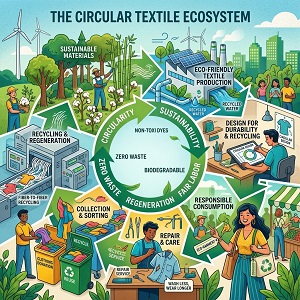

The global fashion industry is beginning to adopt an unconventional strategy by encouraging customers to mend worn clothes instead of continually buying new ones. Amid pressures to reduce environmental pollution and climate change, a number of leading clothing brands are starting to make in-store repair services and sewing workshops a key attraction for young consumers who want to save money while protecting the planet.
Major global brands such as Levi Strauss & Co., Uniqlo, and Primark are racing to win the hearts of consumers from Generation Z by relying on needles and thread. Levi's even launched a specialized hand-stitching training program for high school students after realizing that many young people from this generation have a high interest in thrift store shopping and sustainability, yet lack basic sewing skills.
Through a program titled Wear Longer, employees instruct teenagers for 90 minutes to master four basic skills: sewing on a button, hemming, patching a hole, and fixing a tear. This expansion effort by the San Francisco-based company complements the modification and repair services previously available at hundreds of their stores worldwide. According to Paul Dillinger, Levi's head of global design innovation, empowering consumers through the ownership of clothing care skills is a crucial key to extending the product's life cycle.
This shift in trends from traditional economic needs to strategic marketing methods did not happen overnight. The fashion industry faces intense scrutiny regarding its contribution to environmental pollution. Based on data from the nonprofit organization Ellen MacArthur Foundation, global clothing production increased up to twofold between 2000 and 2015, while the average frequency of wearing each garment actually dropped by 36 percent. Furthermore, less than one percent of discarded clothing material was recycled into new apparel.
On the other hand, Generation Z, born between 1997 and 2012, grew up in the era of fast fashion and e-commerce, and faced school years and young adulthoods shaped by the pandemic and post-pandemic inflation. Factors such as limited budgets and a shifting view of materialism have driven this age group to propel the pre-owned clothing market to grow much faster than conventional retail apparel sales, as estimated by market intelligence firm GlobalData.
Nevertheless, the biggest challenge for the retail industry today is turning repair services from a niche offering into a commercially viable business model. Sweden's H&M Group highlighted the economic barriers in this practice, where the cost of manufacturing new garments is often cheaper than keeping existing products in use through labor-intensive efforts. To entice customers, repair services must be priced low enough even though the process requires a significant amount of labor.