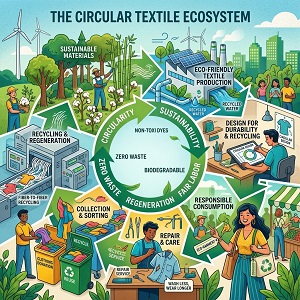

India has taken a progressive step toward addressing its national textile waste crisis by launching a nationwide innovation challenge titled "What Is It Made Of?". This initiative was spearheaded by the Office of the Development Commissioner (Handlooms) under India's Ministry of Textiles as part of the Weave The Future 4.0 program. This move is highly critical given that India generates 70.73 lakh tonnes of textile waste annually. Through this competition, the government is inviting citizens, students, artisans, researchers, designers, and entrepreneurs to develop practical solutions that promote circularity, sustainable production, and responsible consumption by transforming discarded textiles into value-added products.
The competition is open to participants aged 16 to 45 from various fields, including design, engineering, science, technology, communication, and community development. Participants can submit entries across five categories: upcycling, recycling, regenerative design, system design, and supply chain innovation. Submissions for this innovation challenge will close on July 20, 2026. Shortlisted projects will receive opportunities for recognition, public showcasing, prizes, and potential implementation support to help these concepts progress into practical, real-world applications.
In addition to the main competition, the Re-Stitch India initiative has been launched to encourage individuals, institutions, and communities to create 1-meter by 1-meter textile panels using discarded garments, production waste, and reclaimed fabrics. These contributions will be assembled into a large collaborative installation to be exhibited during Weave The Future 4.0, which takes place at Dilli Haat, New Delhi, from July 12–17, 2026. The event will bring together over 100 brands, recyclers, thrift collectives, artisans, and innovators focused on upcycling, recycling, repair, repurposing, and circular design.
Arti Kanwar, Additional Secretary of the Ministry of Textiles, stated that India's textile sector combines centuries of material knowledge with the need for practical solutions to growing waste challenges, and she hopes the competition will identify ideas with potential for implementation beyond the exhibition. Meanwhile, M Beena, the Development Commissioner (Handlooms), emphasized that the initiative recognizes India's longstanding tradition of extending the life of textiles and places that knowledge at the center of the country's circular economy efforts. By uniting various stakeholders—from artisans to innovators—Weave The Future aims to advance sustainable, circular, and craft-led approaches to responsible production and material use.