Public awareness regarding environmental issues and microplastic waste has achieved significant momentum worldwide in recent years. Based on a comprehensive survey released by Cotton Incorporated, which surveyed 28,813 consumers across multiple countries, cotton has emerged as the safest natural fiber for the environment. An overwhelming 85 percent of global respondents believe that cotton is environmentally safe, securing the top position ahead of wool at 81 percent, silk at 76 percent, and hemp at 69 percent.
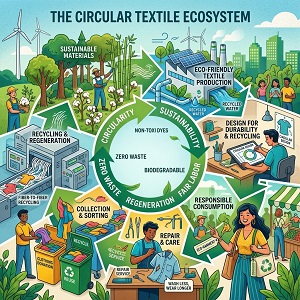
India has taken a progressive step toward addressing its national textile waste crisis by launching a nationwide innovation challenge titled "What Is It Made Of?". This initiative was spearheaded by the Office of the Development Commissioner (Handlooms) under India's Ministry of Textiles as part of the Weave The Future 4.0 program. This move is highly critical given that India generates 70.73 lakh tonnes of textile waste annually. Through this competition, the government is inviting citizens, students, artisans, researchers, designers, and entrepreneurs to develop practical solutions that promote circularity, sustainable production, and responsible consumption by transforming discarded textiles into value-added products.
The Taiwanese textile sector is currently entering a new era, shifting from basic recycled content toward sophisticated circular material systems. This transformation serves as a strategic response to tightening global sustainability regulations. By prioritizing mono-material designs and textile-to-textile recycling technologies, Taiwanese mills are working to resolve the industry’s long-standing challenge of managing the disposal of complex, multi-fiber garments.
Page 3 of 11