
The United Arab Emirates (UAE) has taken a decisive step toward transforming its national textile industry by launching "Naseej," the nation's first integrated initiative dedicated to textile circularity. Announced during "The Fabric of Possibility" event at Yas Mall in Abu Dhabi, this program aims to address the country's textile waste challenge, which generates an estimated 220,000 tons of discarded textiles annually. The initiative, directed by Sheik Mohamed bin Zayed Al Nahyan, seeks to treat textile waste not merely as an environmental concern, but as a strategic opportunity to foster long-term behavioral changes and sustainable practices.
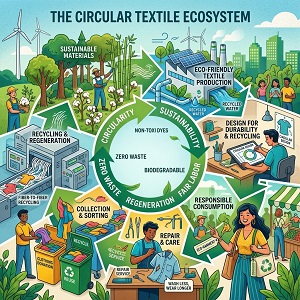
Naseej functions as a collaborative framework, bridging the gap between manufacturers, retailers, recyclers, research institutions, policymakers, and consumers across the entire textile value chain. By bringing these stakeholders together, the initiative aims to combat the rising volume of textile waste driven by increased consumption, rapid population growth, and the proliferation of fast-fashion retail. The program employs a multi-pronged approach that includes expanding collection systems, upgrading sorting and recycling infrastructure, promoting sustainable material innovation, and encouraging consumers to participate actively in waste reduction.
Beyond its environmental goals, the initiative serves as a catalyst for economic growth, creating new avenues for investors and entrepreneurs to develop a circular economy ecosystem for textiles. This aligns with the UAE's broader objective to strengthen its position as a global hub for entrepreneurship. Research indicates that the UAE's high-net-worth investors are increasingly focused on sustainability, with nearly three-quarters expressing interest in sustainability-focused businesses and more than half prioritizing ethical company policies when making investment decisions.
As the UAE's textile market continues to grow—projected to expand from $15.08 billion in 2024 to $20.93 billion by 2029—circularity has been identified as a critical component of the nation's economic future. According to Minister of Economy and Tourism Abdulla bin Touq Al Marri, the initiative will provide both environmental and financial benefits by improving resource efficiency and reducing reliance on imported goods. Moving forward, Naseej will support various pilot projects designed to scale circular economy solutions throughout the UAE's textile sector.