
The 15th annual ACFIF Conference meeting in Penang, Malaysia, became a crucial stage for the Southeast Asian textile industry, especially for Indonesia, which was represented by Redma Gita Wirawasta as the Chairman of the Indonesian Fiber and Filament Yarn Producers Association (APSyFI). In the Country Report presentation titled "Summary Report of the Indonesian Chemical Fiber and Filament Yarn Industry 2026", Redma brought a balanced message between macroeconomic vigilance and fundamental industrial optimism.
Redma opened his report with a greeting that reflected a sense of togetherness among industry players in the region. He stated, "Good afternoon, everyone, it is a pleasure to gather again today to discuss various issues related to the industry that we have been dedicated to for many years." This opening statement became the foundation for a presentation that was not only technical, but also visionary regarding the future of national synthetic fibers.
Macroeconomic Landscape: Between Stable Growth and Monetary Pressure
Fundamentally, Indonesia entered 2026 with fairly resilient macroeconomic figures. National GDP growth remains maintained above five percent, precisely projected at 5.11%. This resilience is driven by household consumption, which contributes half of the national economic activity. However, behind those positive growth numbers, there are structural challenges that are a serious concern for APSyFI. The manufacturing industry, which is expected to be the backbone of the economy with a contribution target above 22%, in reality, is still held back at 19%.
The situation for the textile and garment industry (TPT) is even more challenging. This sector's contribution to the national GDP has slipped below one percent, a drastic decline compared to a decade ago when it was still able to touch three percent. Redma highlighted that exchange rate fluctuations are the variable that drains the energy of industry players the most. The Rupiah exchange rate, which weakened to an average of Rp16,397 per USD in 2025, and even broke Rp17,000 in the first quarter of 2026, has created cost pressures on the input side of imported raw materials.
Redma explained this condition in a pragmatic yet alert tone. He revealed, "However, what has become a challenge again is the weakening of our currency value, which even in the first quarter of this year reached Rp17,000 per USD, although we believe that currency weakening also occurs in other countries as an impact of geopolitical conditions and Fed policies." This phenomenon creates a paradox; on one hand, production costs swell, but on the other hand, Indonesian export products become more competitive in the international market.
Domestic Market Dynamics and Recovery Efforts
The domestic market remains the "heart" for the sustainability of the Indonesian chemical fiber industry. With public consumption growing at around six percent per year, the domestic market is able to absorb 70% of the total national production. In 2025, the value of domestic consumption reached an all-time high of USD 21.59 billion. This is a strong indicator that the demand for textile products at the end-consumer level has not faded, even though the competition map at the producer level is undergoing a major shift.
One noteworthy achievement in Redma's report is the recovery of labor absorption. Although the TPT industry is often reported to be experiencing waves of efficiency, 2025 data shows the number of workers reached 3.95 million people, the highest figure in the last nine years. Redma explained that a "player replacement" process is occurring in this industry. Old companies that are unable to compete are closing operations or reducing employees, but at the same time, new foreign investments are entering with more modern technology and a large capacity for labor absorption.
Redma noted this dynamic as a natural transition. "The textile and garment industry is still growing, albeit slowly; several companies have lowered production or even stopped operations, although several foreign investments have started entering to replace them. Some companies that closed laid off workers, and additional new workers replaced them in new investments," he explained. This shows that Indonesia remains an attractive investment destination due to its complete ecosystem.
Upstream-Downstream Integration and Supply Chain Strength
The main strength of the Indonesian textile industry lies in its vertically integrated structure. This supply chain starts from the petrochemical sector, which processes Naphta into Paraxylene, then processed into Purified Terephthalic Acid (PTA) and Monoethylene Glycol (MEG) as the main raw materials for polyester. On the other hand, the wealth of natural resources in the form of industrial forest plantations provides dissolving pulp, which is the basic material for viscose rayon.
The scale of this industry is massive, covering thousands of business units ranging from micro-scale to giant manufacturing plants. APSyFI data notes that there are more than 360,000 micro-enterprises in the garment sector and more than 4,000 small-scale textile companies. In terms of capacity, Indonesia has enormous production capabilities: Man-Made Fiber reaches 1.5 million tons, Yarn reaches 2.5 million tons, Fabric reaches 2.7 million tons, and Garments reach 2.8 million tons per year. This structure allows Indonesia not only to produce commodities, but also high value-added products that are ready to be marketed globally.
Trade Policy: Shielding the Market from Unfair Practices
In terms of trade policy, Redma Gita Wirawasta gave special emphasis to protecting the domestic industry from unfair trade practices. Although Indonesia is an adherent of open markets through various Free Trade Agreements (FTA) such as the RCEP, the government still implements protection instruments selectively.
Since 2022, the Most Favored Nation (MFN) tariffs for yarn, fabric, and garments have been significantly raised to encourage the use of local products. For example, garment tariffs, which were previously at 20-25%, have now been increased to 20-30%. Redma explained that this step was taken not to isolate the country, but to create a level playing field. "Regarding import tariffs, there has been no change since 2022. Although the MFN tariff looks high, for Southeast Asia and 6 other Asian countries, 95% of tariff lines are already 0% under the RCEP trade agreement," he said.
In addition, Trade Remedy instruments such as Anti-Dumping Duties (BMAD) for Polyester Staple Fiber (PSF) products, as well as Safeguard policies for spun yarn and fabric, remain the government's main weapons in stemming the flood of cheap imported products that often enter through poorly monitored channels. Redma also shared good news regarding the planned implementation of a trade agreement with the European Union, which is expected to open export doors even wider for Indonesian products starting next year.
Chemical Fiber Sector Analysis: Polyester, Viscose, and Nylon
APSyFI's technical report dissected the condition of each chemical fiber segment in great detail. In the Polyester Staple Fiber (PSF) sector, Indonesia's capacity still holds above 700 thousand tons per year. However, production utilization in 2025 only reached around 500 thousand tons due to the closure of several production facilities. There is a worrying trend where export volume is stagnant while imports of cheap products are actually increasing, even though domestic consumption is improving.
A brighter condition is seen in the viscose fiber sector (Viscose Staple Fiber). With a capacity reaching 800 thousand tons and a utilization rate touching 85%, Indonesia has become a key global viscose player. Because this capacity far exceeds domestic needs, most of the production is allocated for export. Interestingly, Redma noted a downward trend in viscose exports caused by an increase in domestic consumption, indicating that downstream industries (fabric and garments) are beginning to shift heavily toward using this cellulose-based fiber.
In the filament yarn sector, the biggest challenge comes from the flood of cheap imported yarn, which has pressed utilization rates down to just 60%. This is highly felt in the textured yarn and Partially Oriented Yarn (POY) segments, where four polymerization companies were forced to stop production. However, optimism arises from plans for major foreign investment in this sector, which is expected to bring new technology and refresh the national filament yarn ecosystem.
The nylon and Spin Drawn Yarn (SDY) sectors show better resilience. Although their production is not as large as polyester, domestic producers have managed to counterbalance import pressures through solid export performance, keeping utilization maintained at 65%.
The Future of PET: From Bottles to Global Textiles
One of the most crucial points in Redma's report is the future of PET (Polyethylene Terephthalate), both in the form of bottles and film. Currently, the domestic market is indeed still dominated by imported goods, and domestic production is mostly allocated for the export market (around 85%). However, a major shift is occurring in this sector along with the emergence of new investments in the field of Recycled PET (rPET).
Redma predicts that with investment plans from two major companies with a total capacity of 1.5 million tons, the world's PET power map will shift. Indonesia will not only reclaim its domestic market, but will also have a significant influence on global supply. This aligns with the shift in world consumer preferences that are beginning to demand sustainable raw materials.
Vision 4.0 and Sustainability: Indonesia Towards Green Industry
Closing his report, Redma Gita Wirawasta underlined that the future of the Indonesian chemical fiber industry no longer depends on volume alone, but on the values of sustainability and technological advancement. Redma stated with full confidence, "Although there appears to be some performance decline, especially in the polyester industry, the Indonesian chemical fiber industry in the future will still be able to meet its domestic needs and is even expected to return to being a main challenger in the global market."
APSyFI's future vision rests on three main pillars: Green, Environmentally Friendly, and Sustainability. Indonesia has started implementing very strict Green Industry Standards, beginning from the viscose sector and will soon be expanded to the polyester and nylon sectors. Energy transformation is also a focus, where many companies are starting to invest in solar panels and targeting a 90% reduction in the use of coal.
The development of products towards Advanced Textiles supported by digitalization and the use of Artificial Intelligence (AI) has become a strategy to remain competitive. Redma believes that the complexity of regulations in Indonesia does not deter investors' intentions as long as the future vision is clear. "With a green, environmentally friendly, and sustainability vision, product development towards advanced textiles, to the implementation of digitalization and the use of Artificial Intelligence, we believe we will still remain competitive in this business," he asserted.
The Road to Self-Sufficiency and Global Competition
Based on the report presented at the 15th ACFIF, it is clear that the Indonesian chemical fiber industry is in a crucial transformation phase. Despite being hit by currency weakening and unfair import competition, the strength of the domestic market and the flow of new investments provide a strong foundation for recovery.
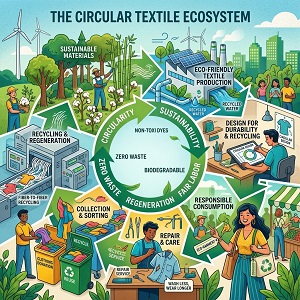
Indonesia is not merely surviving, but is rebuilding its strength through import substitution policies, trade remedies, and the implementation of green industry standards. With integration from upstream petrochemicals to downstream garments, as well as a focus on Circular Economy concepts like Bottle to Textile, Indonesia is projected to achieve self-sufficiency in chemical fibers and strengthen its position as a leader in the sustainable textile industry in Asia and the world. Redma Gita Wirawasta and APSyFI have set a high standard: making the textile industry not just a legacy of the past, but an engine of modern economic growth that is environmentally friendly and high-tech.