
The Netherlands is preparing to make a historic mark on the global technical textile industry by hosting its first-ever national pavilion at the prestigious Techtextil trade fair, held from April 21–24, 2026, in Frankfurt, Germany. Organized under the umbrella of the industry association Modint, the pavilion will serve as a stage for a curated group of pioneering Dutch textile innovators. Their collective ambition is clear: to accelerate the transition toward a circular and digitally advanced sector. This move is viewed not merely as a progressive trend but as an economic imperative, given that the Dutch textile, clothing, and footwear industry generates approximately €24 billion annually, accounting for 2.4% of the national income.
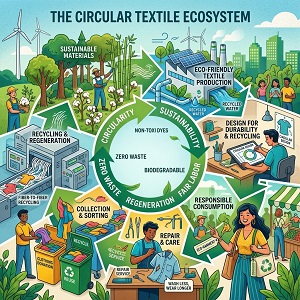
The pavilion’s debut will showcase cutting-edge technologies that transform waste into high-value economic opportunities. A major highlight is SaXcell, which introduces fiber-to-fiber recycling technology capable of converting discarded cotton into high-quality new raw material. Sustainability challenges are further addressed by Lamoral Coatings through PFAS-free performance finishes that maintain functionality even after repeated washing. Beyond physical materials, digital transformation takes center stage through tex.tracer, an automated data-driven platform that replaces manual tracking to provide real-time transparency across the garment supply chain.
Other exhibitors will demonstrate how circularity has moved from a niche concept to large-scale industrial practice. Vodde, for instance, has successfully collected millions of kilograms of discarded textiles to be transformed into high-quality socks and yarns. Meanwhile, designer Eva de Laat, through her Materialliance platform, provides digital material intelligence that allows product developers to make technically robust choices regarding fabric construction. Other unique innovations include EeCoff, which introduced recycled polyester fabric colored using pigments from carbonized coffee grounds, and EE Labels, which developed woven QR codes that remain scannable throughout a product’s entire lifecycle to strengthen traceability.
Despite this collective ambition facing hurdles such as regulatory uncertainty regarding mandatory recycled content, Dutch entrepreneurs are demonstrating remarkable resilience and market readiness. "It is important to position the Netherlands as an innovative circular textile brand," says Pieter van Kessel, co-founder of the Circular Textile Days initiative. He emphasized that through this curated pavilion, participants gain global visibility while strengthening one another through collaboration. Echoing this sentiment, Nanette Hogervorst, Innovation Director at Modint, noted that government support through the Circular Textile Action Plan has made this collaboration possible. According to her, Techtextil is Europe’s ultimate meeting point where the scale of industrial impact can truly be expanded in a matter of days.