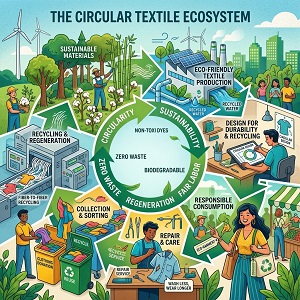

As the global fashion industry faces mounting pressure to address its environmental footprint, India is positioning itself to turn mountains of fabric waste into a goldmine. According to a landmark report titled "Mapping of Textile Waste Value Chain in India," launched by Union Textiles Minister Giriraj Singh, the country's textile recycling market is projected to skyrocket to $3.5 billion by 2030. This green evolution is expected to do more than just clean up the planet; it is forecasted to generate approximately 100,000 new "green jobs" across the nation.
Speaking at the report’s unveiling in New Delhi, Minister Singh emphasized that as one of the world's largest textile producers, India has a unique responsibility and opportunity to lead the global transition toward a circular economy. "It is vital that the rapid expansion of our textile industry aligns with our sustainability goals," Singh stated, highlighting that the sector is no longer just about manufacturing, but about the sophisticated recovery of resources.
The scale of the challenge—and the opportunity—is massive. India generates an estimated 7.07 million tonnes of textile waste annually. The report breaks this down into two main streams: 42% originates from pre-consumer sources, such as factory offcuts and manufacturing scraps, while 58% comes from post-consumer waste discarded by households. Currently, India is already punching above its weight in recovery; over 70% of total textile waste is diverted from landfills and routed into recycling, upcycling, or reuse.
A significant hero in this narrative is the city of Panipat, which has emerged as a global nerve center for mechanical recycling. Here, waste from across various textile clusters is transformed back into usable fiber. The report also launder the efficiency of the spinning sector, which has set a "closed-loop" benchmark by reintegrating nearly 100% of its process waste back into production. This level of efficiency is driven by the close proximity between waste generation and processing facilities.
Beyond the machinery, India’s recycling success relies heavily on a vast, intricate informal network. Approximately 55% of post-consumer waste is collected and sorted by an informal workforce of 4 to 4.5 million people—predominantly women from marginalized communities. By formalizing these networks and developing better infrastructure at the cluster level, the report suggests India can significantly boost its efficiency.
By 2030, India aims to prove that economic growth and environmental stewardship are not mutually exclusive. With a $3.5 billion market on the horizon, the message is clear: the future of Indian fashion is not just in the weaving of new threads, but in the masterful recovery of the old ones.