
The global textile and garment industry no longer rests on the same foundations it did five decades ago; we are witnessing a tectonic shift that is transforming production structures from labor-intensive to technology-driven and sustainable. Projections for 2026 indicate that this sector stands at a crossroads between radical efficiency and non-negotiable environmental ethics. However, this technological narrative does not exist in a vacuum; it is deeply influenced by an increasingly fragmented global geopolitical landscape. If globalization was once measured by the length of supply chains crossing oceans, the success of today’s textile trade is determined by a company’s ability to navigate protectionist policies and sharp competition between economic blocs.

The most significant technological leap leading this projection is the convergence of advanced robotics and Artificial Intelligence on a manufacturing scale. The maturation of "Sewbots" and automated stitching has shattered the long-standing assumption that textiles will always be an industry chasing low wages. Geopolitically, this has triggered a massive phenomenon of "reshoring" and "friend-shoring." Western nations are increasingly moving their production hubs back to their own borders or to close allied nations to avoid the risks of supply chain disruptions—often fueled by diplomatic tensions or regional conflicts. Speed-to-market has become the new currency, far more valuable than traditional labor cost savings in politically volatile regions.
Palaniswamy Rajan, a pioneer in textile automation, once observed that the future of this industry lies not in machines repeating human tasks, but in creating a responsive production ecosystem. In the context of global trade, this responsiveness serves as a shield against the uncertainty of tariff policies. Market analysis shows that automation allows brands to perform mass customization and high-precision small-batch production. Consequently, the structure of world trade is shifting from slow, massive container shipments to smaller, rapid cross-border air or land cargo, aligning with the autonomous and unpredictable movements of social media trends.
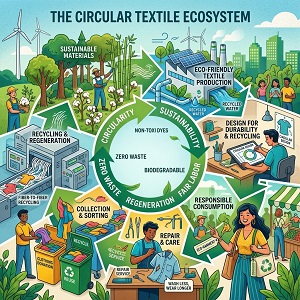
However, technological sophistication is only one side of the coin; the other is the urgent demand for circularity, which is now being politicized through international trade regulations. The global textile industry faces mounting pressure from regulations such as the Carbon Border Adjustment Mechanism (CBAM). 2026 industry projections place circularity as a core pillar of the garment economy, serving simultaneously as a new geopolitical instrument to limit market access for countries still relying on "dirty" energy or environmentally damaging processes. Clothing is now treated as a data asset; the use of blockchain technology enables the transparency required by international trade laws to ensure the absence of forced labor or human rights violations in the fiber supply chain.
Achim Berg, a global fashion strategy expert, stated in a recent analysis that we are moving from a "take-make-dispose" model toward a digitally integrated closed-loop system. He argues that the future of textile trade will heavily depend on compliance with global green standards. Geopolitically, this creates "green trade blocs" that benefit members but pose significant barriers to developing nations that are slow to adopt circular technologies. Countries unable to prove supply chain transparency through digital passports on garment labels are predicted to lose access to high-purchasing-power markets.
From a macroeconomic perspective, the power map of the world’s garment industry is undergoing a repositioning triggered by "de-risking" policies toward traditional manufacturing giants. While established players remain dominant, nations like Vietnam, Indonesia, and India are racing to transform into centers of technological excellence to attract investment from global brands seeking diversification. Massive investments in digital textile printing and robotic sewing in these countries are no longer optional—they are prerequisites for remaining competitive amidst increasingly discriminatory import tariffs. Projections show that countries with geopolitical stability and a commitment to renewable energy will be the new winners in attracting factory relocations from global brands.
This analysis leads us to the conclusion that the textile industry of 2026 is one that is smart, localized, and highly sensitive to the shifting political winds of the world. The on-demand business model, where clothing is produced only after an order is placed, is drastically changing the risk profile for international trade by cutting global overstock by up to 30%. This reduces trade deficit pressures for many importing nations as they only purchase what is truly consumed. Ultimately, these projections portray a future where fashion is no longer just about aesthetics, but about resilience and ethics in an uncertain world. The global garment industry is reweaving its destiny, moving from a legacy of pollution toward a future of clean, transparent innovation that is resilient to geopolitical shocks.