
The global fashion and outdoor industry has just witnessed a major paradigm shift in how products are manufactured and consumed. Amidst growing international scrutiny over mounting textile waste, Canadian outdoor powerhouse Arc’teryx has officially partnered with the legendary Swiss textile testing institute, Testex AG, to launch one of the most rigorous circularity certifications in the industry to date. This move, announced in February 2026, is far from a standard green marketing ploy; it is a systematic effort to redefine sustainable apparel through the "Testex Circularity" label.
This strategic partnership unites two titans from different continents. Arc’teryx, based in North Vancouver, has been a leader in high-end technical apparel innovation since 1989. On the other side, Zurich-based Testex AG is an independent authority that has served as the backbone of global textile safety standards for decades. Both organizations agree that the greatest enemy of true sustainability is "greenwashing"—unsubstantiated environmental claims. Consequently, this certification was born to provide empirical evidence that a jacket or pair of trousers is genuinely designed to last longer, be easily repaired, and eventually be fully recycled.
The timing of this initiative is no coincidence, as the pressure on the fashion industry has reached a tipping point. Global regulations, particularly the tightening circularity laws within the European Union, are putting brands under a microscope. For Arc’teryx, this move is a cornerstone of their ambitious roadmap to slash supply chain emissions by 42% by 2030. By ensuring products have an extended lifespan, the demand for virgin material production is significantly reduced. The benefits extend directly to their buyers—ranging from professional alpinists to eco-conscious urban consumers. Products carrying the circularity label offer more stable investment value and higher resale prices on the secondhand market due to their independently verified technical quality.
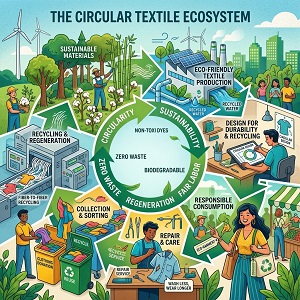
The certification process conducted by Testex is exhaustive, covering structural fabric integrity, the durability of trims like zippers, and even the ease of garment disassembly so that fibers can be reprocessed into new raw materials. Andrew Yip, Senior Director of Advanced Concepts Materials at Arc’teryx, emphasized that while durability has been at the core of the brand’s DNA since its inception, the industry has long lacked a consistent standard to measure circularity. He noted that collaborating with Testex was a natural progression to provide a technical framework that is globally accountable.
Echoing this sentiment, Marlène Maury of Testex stressed that circularity can only succeed if it is measurable at the product level with total transparency. The presence of this label offers honest information to increasingly skeptical and critical consumers. International textile experts have lauded the move, viewing the Arc’teryx and Testex standardization as a new benchmark that will compel global manufacturers, including those in Asia, to adapt quickly. In the near future, clothing will no longer be judged solely on how good it looks when new, but on how intelligently it was designed to never end up in a landfill.