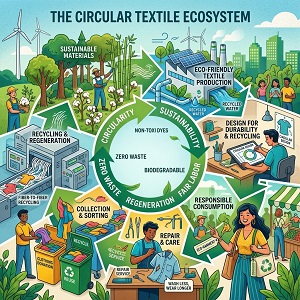

The global fashion industry is witnessing a seismic shift as sustainability moves from a niche concept to a dominant market force. Recycled fashion is no longer sitting on the sidelines; instead, it is accelerating at an unprecedented pace. Recent data from UK-based supplier A.M. Custom Clothing reveals a staggering 76 percent year-on-year increase in garments produced from recycled materials. However, despite this rapid growth, the industry’s long-standing love affair with cotton remains unshaken, with organic cotton volumes still tracking seven times higher than recycled alternatives.
This trend highlights a complex reality: while consumers are hungry for eco-friendly options, they remain loyal to the comfort and familiarity of natural fibers. Public interest has reached a five-year peak, evidenced by Google Trends data showing a 222 percent spike in searches for "sustainable fashion" in the weeks leading up to February’s Fashion Week. Yet, the shift isn't just about picking the "greenest" label anymore—it is about performance, durability, and the functional end-use of the garment.
Alex Franklin, co-founder of A.M. Custom Clothing, notes that brands are now approaching circularity with a more sophisticated lens. "Brands are thinking more seriously about circularity: not just how garments are made but how well they’ll last and perform so the wearer can enjoy them with a clearer conscience," Franklin explained. He pointed out that while recycled polyester (RPET) is carving out a vital space in performance-led sectors like sportswear due to its quick-drying nature, cotton continues to dominate because of its established supply chains and easily communicable ethical origins, such as Fairtrade certifications.
The rise of the "cost-per-wear" mindset—driven partly by global cost-of-living pressures—has further influenced this material tug-of-war. Modern shoppers are increasingly prioritizing longevity over fast-fashion bargains, favoring fabrics like linen, viscose, and lyocell, which have seen growth rates of 73, 54, and 42 percent respectively over the last five years. These plant-based fibers offer a blend of lower environmental impact and versatility that resonates with the practical consumer.
Ultimately, the industry's evolution suggests that the future of fashion won't be defined by a single "miracle" material, but by a thoughtful balance. As regulatory scrutiny and ESG requirements tighten, brands are moving away from simple material substitution and toward deep-rooted product development. The goal, as Franklin suggests, is to select the best material for the wearer's experience. Sustainable fashion is evolving into a discipline of precision—balancing the innovation of recycled synthetics with the enduring reliability of organic natural fibers to ensure clothes stay in our closets and out of landfills.