
The United States textile and apparel industry is navigating a challenging period as weakening global demand continues to pull down national export figures. According to the latest data from the Office of Textiles and Apparel (OTEXA), a division of the U.S. Department of Commerce, sector exports declined by 3.63 percent to $16.732 billion during the first nine months of 2025. This downturn marks the second consecutive annual decline, effectively reversing the post-pandemic rebound seen in 2022.

In a decisive move to reclaim its domestic market, Mexico has officially launched a high-stakes trade offensive. The Mexican Senate recently approved a landmark tariff bill, imposing duties as high as 50% on nearly 1,500 products—with apparel, textiles, and footwear at the very heart of the protectionist strategy.

This policy, championed by President Claudia Sheinbaum, is a direct response to the "deluge" of cheap, China-made goods that have threatened to suffocate Mexican manufacturers for years.

President Sheinbaum framed the decision as a necessity for national economic survival. The tariffs target countries with which Mexico does not have an active trade agreement, primarily focusing on China. Over the last decade, Chinese imports into Mexico have nearly doubled to a staggering $130 billion, while Mexican exports to China remain under $10 billion.

"We want Plan Mexico to be fulfilled without causing a problem for the national economy," Sheinbaum told reporters. "The goal is to strengthen the national economy while keeping the dialogue open."

The government estimates these new duties could generate approximately $2.8 billion in revenue over the coming year, providing a much-needed financial cushion to revitalize the local textile industry, which has struggled significantly since the pandemic.

The timing of these tariffs is no coincidence. Mexico is preparing for a critical review of the United States-Mexico-Canada Agreement (USMCA) in July 2026.

The U.S. government, particularly under the pressure of President Donald Trump’s trade policies, has voiced growing concerns that Mexico is being used as a "backdoor" for Chinese goods to bypass U.S. tariffs. By enacting these aggressive duties and reforming its Customs Law to penalize undervaluation and misclassification, Mexico is signaling to Washington that it is a disciplined and reliable partner in the North American trade bloc.

The international response was swift. China’s Ministry of Commerce denounced the move, labeling it "unilateralism and protectionism." While Mexico insists it values its relationship with Beijing, the 50% tariff wall suggests that domestic job security outweighs diplomatic niceties for now.

Meanwhile, the U.S. has also intensified its trade actions in the region, hitting Nicaragua with 15% tariffs over human rights and labor violations. These converging policies indicate a broader shift toward a more fragmented and protective global trade environment in the textile and garment sectors.

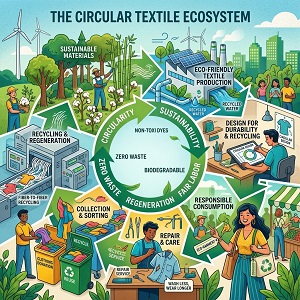
A groundbreaking report has shed light on a significant economic opportunity lying dormant within the United States: textile-to-textile recycling. According to the report, this industry holds the potential to unlock a staggering $1.5 billion if approached correctly. However, despite the vast potential, the current state of textile disposal in the US is far from optimal, with a mere 15 percent of the country's 17 million tons of textile waste being recovered, leaving a staggering 85 percent to end up in landfills or incinerators.